


Why should you replace your helmet after a fall? The proof on video
We often say it: a helmet that has taken an impact must be replaced, even if it looks intact to the naked eye. But why? To show it in concrete terms, we ran a full-scale test on our impact testing machine, the same type of machine we use to test our helmets and that official certification laboratories use.
How the test works
We subjected a helmet to a first impact on a precise point of the shell, measuring the shock absorption curve, in other words how the energy of the impact is absorbed before it reaches the head. This curve directly reflects the level of protection provided at the moment of impact: the lower it is, the better the helmet absorbs the impact.
We then subjected the helmet to a second impact, in exactly the same spot. The result is clear: the absorption curve of the second impact is significantly worse than that of the first. The materials deformed by the first impact, both the inner polystyrene and the outer shell, can no longer absorb energy in the same way. Their protective capacity is reduced, even though the helmet showed no visible damage between the two tests.

What this test shows
This confirms what we regularly remind our riders: the safety components of a helmet (the shell and the inner polystyrene) are permanently deformed by an impact, even when the deformation cannot be seen with the naked eye. A helmet that protected you once will not protect you the same way a second time.
This is why all protective helmet manufacturers, not only in equestrian sports, recommend systematically discarding a helmet after an impact. This instruction, found in every safety manual, is not an excessive precaution: it is based on a measurable reality, which our test makes visible.
A regulatory requirement
This instruction is not just common sense: it comes from a regulatory requirement. The EN 1384:2023 standard, which governs the certification of equestrian helmets, requires manufacturers to include this instruction to discard the helmet after an impact in the user manual supplied with every helmet. This requirement is itself part of the European regulation on personal protective equipment (Regulation (EU) 2016/425), to ensure the product is used safely. To learn more, read our article to understand equestrian helmet safety standards.
Our recommendation and the NACA service
If your helmet has been through a fall with an impact to the head, don't take any risks: send it back to us for inspection.
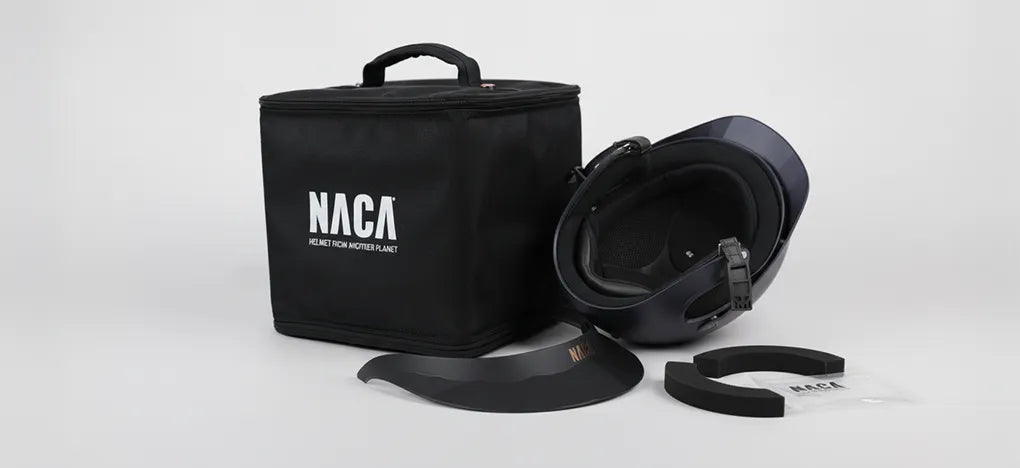
We know that replacing a helmet after a fall is a hassle, especially if you bought it recently. For your safety, and to stay within the legal framework, we offer to replace both safety components (the shell and the inner polystyrene) at a reduced cost, so you leave with a new helmet. We don't just replace the inner polystyrene: the shell, which also helps absorb the impact, is replaced too.
This service is carried out in our workshop in the South of France, the same one that makes our helmets every day, to guarantee a replacement that meets the production standards for which the helmet was certified: the same craftsmen, the same operations, the same adhesives, and the same care as a helmet on the production line. Because your satisfaction and your safety come first.

All the information about this exclusive NACA service is available on our Warranty and After-Sales Service page.
Frequently asked questions
Can a helmet be repaired after a fall?
No, repairing a helmet after an impact is not permitted. However, replacing the safety components that absorbed the impact (the shell and the inner polystyrene) amounts to replacing your helmet with a new one. It is neither possible nor permitted to replace only one of these two components and consider it an effective and safe repair.
Do I need to replace my helmet if I drop it from my hands or a shelf?
Not necessarily. A helmet is designed to absorb an impact with the head inside during a fall from a horse, which involves far more energy than a drop of a few dozen centimetres. In this case, a simple visual inspection is usually enough: check for cracks, deformation or visible impact marks on the shell. If in doubt, or if the helmet fell from a height or onto a very hard surface, send it to us for inspection.
Is replacing the safety components cheaper than buying a new helmet?
Yes, that is the whole point of this exclusive NACA service: replacing the shell and the inner polystyrene costs less than a new helmet, with the same level of protection as a helmet fresh off the production line. We only ask for a small financial contribution. See the pricing details on our Warranty and After-Sales Service page.
How do I know if my helmet has taken an impact strong enough to be replaced?
The most reliable criterion is the context of the impact, not the appearance of the helmet: any fall from a horse with a direct blow to the head against the ground, an obstacle or any other hard object should lead to a replacement, even if the helmet looks intact.
Some signs confirm that a replacement is needed: a visible crack or deformation on the shell, a different sound or feel from the polystyrene when you press lightly on it, or new discomfort when wearing the helmet. But the absence of these signs does not guarantee that the helmet still protects you: as our test shows, an impact can reduce its absorption capacity without leaving any visible trace. If in doubt after a fall with an impact to the head, send it back to us rather than relying on a visual inspection.